Starting a business is no small task. Starting a business in a foreign country is even harder. To get you started, we have made a list of six considerations as you begin to register a company in Taiwan. If you ever feel that you need help, our team of accounting and consulting professionals stands ready to assist you with any part of this process.
1. Have a Chinese business name
The official language in Taiwan is Chinese. The Taiwan Company Registry requires an official Chinese company name when registering a business in Taiwan. You cannot choose a business name that is already taken by another company. Check the availability of your preferred business name through the platform from the Administration of Commerce, MOEA. Once the company is registered, key details — name, capital, directors, address, registration date, and business scope — become publicly available on MOEA's online company information inquiry system.
Taiwan Company Information Inquiry Platform
Official Chinese business names in Taiwan are Chinese, which means English names are usually just translations. However, there are many circumstances where a Taiwanese company needs an English name, such as accepting international bank payments or exporting goods. Under those conditions, a Taiwan company can officially register its English name at the International Trade Administration, MOEA (formerly the Bureau of Foreign Trade).
Choosing a good Chinese business name is a good start for your business. Our team can assist in creating a Chinese business name that reflects the sound or the meaning of your English name.
Branch name
Unlike a company name, a branch name must follow a specific format:
Name of parent company + Taiwan Branch + (County)
Example: ABC Co., Ltd. Taiwan Branch (Singapore)
2. Choose a business structure
Choosing the right business structure for your venture is important, because the choice can affect tax liabilities, regulatory requirements, and ultimately the success or failure of a company.
If you are considering Taiwan company setup, you might also want to explore setting up a branch office.
The table below compares the main characteristics of the most common company structures for foreign investors. Download Comparison PDF
Business Entities for Foreign Investors in Taiwan:
- Company Limited by Shares
- Limited company
- Branch Office of the foreign company
Topic 1: Limited Company or Branch Office?
A branch office is not a distinct legal entity, whereas a subsidiary is regarded as an independent Taiwanese company. From a practical point of view, a branch is an extension of the parent company. It cannot act by itself and has no board of directors. A limited company may be wholly owned by a foreign parent but can operate on its own behalf, and must follow corporate formalities, such as having its financial statements approved by the shareholders each year. A branch office is treated as a permanent establishment of the foreign head company by tax authorities.
Advantages of setting up a limited company (subsidiary):
As the subsidiary and the parent company are distinct legal entities, the parent company is not exposed to any liabilities of its subsidiary — the liability of the Taiwanese subsidiary is limited to its own assets. By contrast, a foreign investor is always liable for the activities of its Taiwan branch. This means the branch's liabilities can be enforced at the expense of the foreign investor's assets, even if these are located abroad.
Advantages of setting up a branch office:
- No minimum assigned capital is required.
- Taiwanese corporate law does not impose requirements regarding the establishment of a board of directors, the distribution of profits, or the organization of shareholders' meetings.
- No profit remittance tax on branch profits.
- Losses made by the branch may be offset immediately against the earnings of the head office.
Topic 2: Comparison of Limited Company and Company Limited by Shares
1. A limited company is organized by one or more shareholders, each with liability limited to the amount of capital contributed. Most single-owner businesses choose this form. A limited company is not required to hold formal shareholder meetings — shareholders can make decisions via written consent agreement.
A company limited by shares is organized by two or more individual shareholders (or one or more corporate or government shareholders) and its capital is divided into shares. Shareholders' liability is proportional to their shareholdings. It must hold shareholders' meetings and have at least one supervisor; a board of at least three directors is required unless the articles provide for only one or two directors.
As of 2024, 75% of all registered companies in Taiwan were limited companies, and 25% were companies limited by shares, including closely held companies.
2. The advantages of Limited Company and Company Limited by Shares
Limited Company:
A limited company can be established with only one shareholder and does not need a supervisor, which makes it easier to set up; if there are two or more shareholders, the transfer of shares must be approved by the others, so the shareholding structure is relatively stable.
Company Limited by Shares:
A company limited by shares must have at least two natural-person shareholders or at least one government or legal-person shareholder, so it is usually larger. The Company Act also requires a supervisor, which is more stringent in terms of corporate governance. Its shares can be freely transferred without the consent of other shareholders, allowing a greater degree of freedom in the movement of shareholdings.
FAQ:
Can a foreign national or company own 100% of the shares of a Taiwanese company?
Yes. Unlike other countries such as Thailand and the Philippines, where a foreign national or an international company cannot own 100% of the shares of a company, the Taiwanese government allows a foreign national or company to own 100% of a Taiwanese company.
Can a foreign national be a director or a supervisor of a Taiwanese company?
Yes. The director, the supervisor, or the responsible person of a branch can be a foreign national.
Is it necessary to own shares to become a director?
For a limited company: yes, the director must hold shares. However, when a company acts as a shareholder of another company, its authorized representative can be elected as a director, and that representative is not required to be a shareholder.
For a company limited by shares: no, it is not necessary to own shares to be a director or a supervisor.
What are the "permitted activities" for a Representative Office?
The permitted activities are signing contracts, bidding, purchasing, quoting, and bargaining. A representative office that provides support operations to its foreign head office — such as marketing support, sales support, and support for technical issues raised by customers — which are beyond the scope permitted by the government, may face tax and legal compliance problems. Please see the article The Business Scopes of the Representative Office in Taiwan.
3. Determine business activities
Tell the government what business you are going to do. Select one or more business scopes that your company will engage in. The business scopes must be clearly stated at the time of company incorporation, and must be in the categories that MOEA has predefined. You can find the list of business scopes at the Ministry of Economic Affairs, or you can download them here.
Prohibited and Restricted Business Activities
a. Prohibited Business Activities
Foreign investors are prohibited from investing in industries that could negatively impact national security, public order, good morals, public health, or any industries expressly prohibited by law.
b. Restricted Business Activities
For industries subject to restrictions under law or regulations, investors must obtain prior approval or consent from the competent authority before making such investments.
Negative List for Investment by Foreign Nationals
Apply for a License for a Chartered Business or a Factory License
a. Business Licenses and Permits
Before registering your business, it is important to determine whether your activities are restricted. In Taiwan's company registration system, business activity codes ending in '1' denote regulated industries requiring special permits. Meeting specific criteria is typically required to obtain these permits. For example, a pet store that breeds, trades, and fosters pets (A401031 Pets Service Manufacturing 寵物服務業) needs a business permit from the Ministry of Agriculture. A pharmaceutical company (C802041 Drugs and Medicines Manufacturing 西藥製造業) needs a permit from the Ministry of Health and Welfare.
b. Factory Registration
Manufacturers whose plant area or production equipment (power capacity or heat output) reaches the statutory thresholds are required to obtain factory registration. The process involves submitting an application to the local government and undergoing an on-site inspection to ensure compliance with safety and environmental standards. Once approved, the company will be issued a factory registration certificate. Registration does not need to be renewed, but changes to the factory must be registered, and businesses must remain in compliance to keep it valid.
4. Identify shareholders and directors, and decide the articles of association
First, the Company Act requires that every company must have at least one shareholder. Shareholders may be either corporate entities or individuals of any nationality. The ownership structure can have important tax implications — see Understanding Dividend Tax in Taiwan: How Shareholder Structure Affects Tax.
Extension reading: What should I know before accepting to be a director, branch manager, or appointed manager of a Taiwan company?
Second, you are required to disclose the investor's holding structure down to the ultimate beneficial owner, who must be an individual. This involves providing the shareholder list for each layer of the holding companies.
You are required to authorize an investor agent as a legitimate attorney regarding company formation and registration. Your company's investor agent must be a Taiwan resident and must possess sound knowledge of the Taiwan Company Act. Our qualified specialists can provide your firm with these services.
Deciding the paid-in capital is also important. Although there is no minimum paid-in capital requirement, we suggest the amount should be sufficient to fund the operation of the Taiwanese company for at least the first three months after incorporation.
Finally, a well-planned article of association is a critical foundation for a startup. This important document specifies the company's capital, number of shares, value of shares, agreements regarding relations between shareholders such as shareholders' rights, and the company's operational policies.
FAQ:
What is the minimum capital for limited companies and companies limited by shares?
There is no statutory minimum capital requirement. However, to ensure smooth operations, we recommend setting a capital amount sufficient to cover the company's business activities for at least three months without relying on additional funding. If the initial capital is set too low, the authorities may require the company to submit a three-year financial plan demonstrating its ability to operate sustainably with limited capital. In practice, however, banks usually expect a capital of at least TWD 500,000, or even TWD 1,000,000, before they will open the preparatory bank account.
In addition, if you plan to apply for a work permit for a foreign national to serve as the company's manager, the company must have a minimum paid-in capital of NTD 500,000.
Can the company spend the paid-in capital after the capital verification?
Yes. Once the company is registered, the capital belongs to the company and can be spent on its business, such as rent, salaries, equipment and inventory.
What Article 9 of the Company Act prohibits is giving the money back to the shareholders, or letting them take it back, after registration. The responsible person can face up to five years' imprisonment and/or a fine of NTD 500,000 to 2,500,000, must compensate any damage jointly with the shareholders, and the company's registration can be revoked.
Keep invoices and receipts showing how the capital was used, and never move it to a shareholder's personal account.
Can I register the company in a business center temporarily?
Yes. You may temporarily register your company at a business center or even at your home, and relocate to a permanent office later. However, certain types of businesses — such as import/export and trading companies, restaurants, and manufacturers — are not permitted to register at a business center or residential address. In such cases, the government may reject the application.
Do foreign documents need to be notarized or apostilled?
Corporate documents of a foreign shareholder, such as the certificate of incorporation, board resolution and power of attorney, must be notarized locally and then legalized by the Taiwan representative office (e.g. TECO) in that country. Taiwan is not a party to the Apostille Convention, so an apostille alone is not accepted; in some countries an apostille or foreign-ministry authentication is needed before the Taiwan office will legalize the documents.
5. Determine registered office, open a bank account, and inject capital
Choosing a suitable registered address might seem straightforward, but there are numerous regulations and practical considerations to keep in mind. Whether you are looking at a residential area, a rental property, or a business center, each option comes with its own set of advantages and limitations.
Extension reading: Choosing the Right Registered Address
Before incorporation, the company must open a preparatory bank account to receive the initial capital injection. After the funds are deposited, the Department of Investment Review confirms the amount invested, and a CPA verifies the capital as part of the incorporation process. Please refer to the article: Opening a bank account in Taiwan.
FAQ:
Must the chairman visit the bank in person to open a bank account?
Opening a preparatory account to deposit the capital before incorporation is a mandatory step for both company and branch registration. After the company is incorporated, the director or chairman must visit the bank again to convert the preparatory account into a formal corporate bank account.
During the Covid-19 outbreak, some banks allowed the chairman to open a business account without being physically present. At present, however, nearly all banks in Taiwan require the chairman to visit the bank in person to complete the account opening process.
6. Timeline and post-incorporation compliance
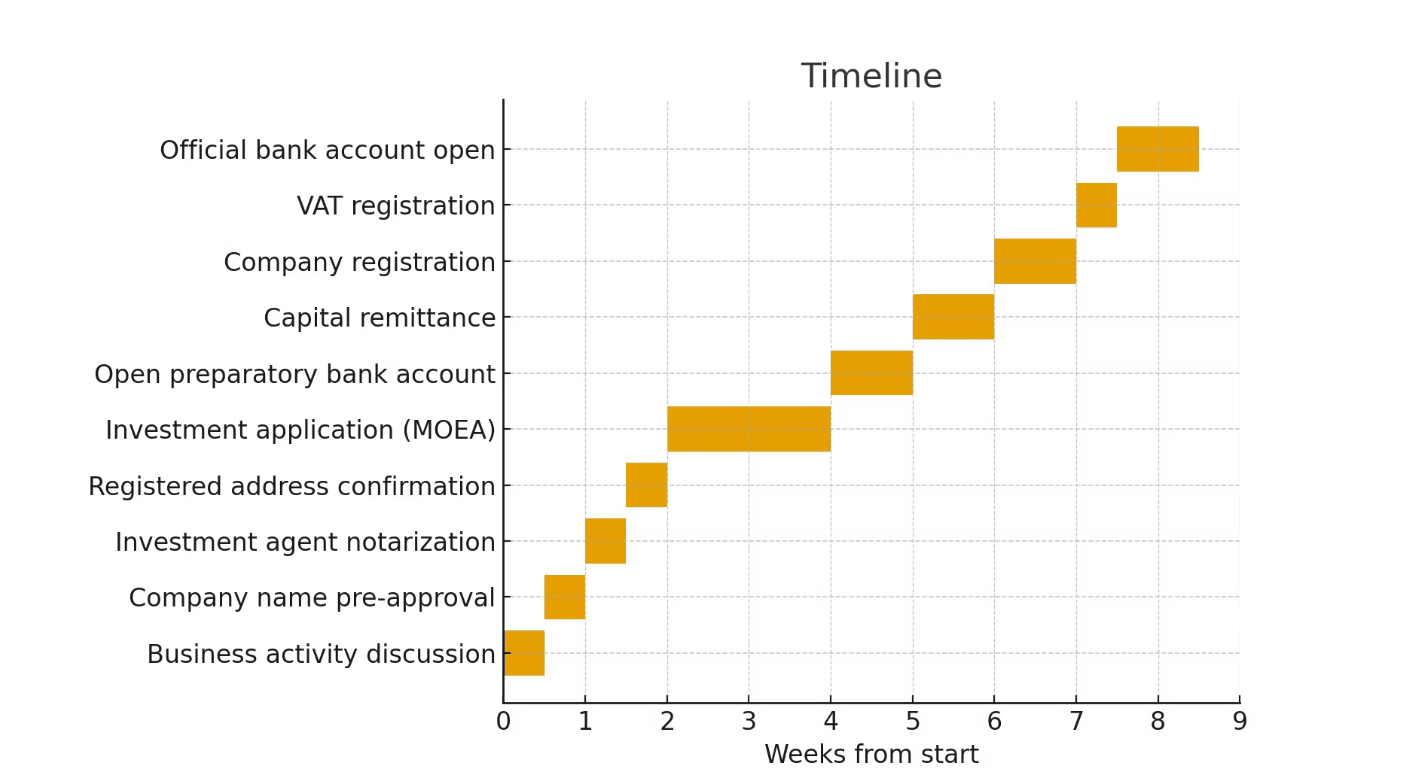
Timeline. For a foreign-invested company, the whole process from name reservation to tax registration usually takes about 7 to 10 weeks. The longest step is the investment approval by the Department of Investment Review, MOEA, which by law is decided within one month after a complete application (two months if other authorities are involved).
Right after incorporation
Export/import registration. Businesses must apply to the International Trade Administration, MOEA to register as importers or exporters in Taiwan. After approval, an import/export license will be issued. In some cases, additional permits or certifications, such as product-specific permits or certificates of origin, may also be required. Violations can result in fines, penalties, or disruptions to operations.
Work permit application. If the company intends to employ foreign nationals, it must apply for work permits through the Ministry of Labor. The process generally requires proof of sufficient paid-in capital, employment contracts, and supporting documentation of the employee's qualifications.
Trademark registration. Companies may register their trademarks with the Taiwan Intellectual Property Office to secure brand protection in Taiwan. Registration helps safeguard against infringement and ensures exclusive rights to use the mark in commerce.
Copyright and patent registration. To protect intellectual property, companies may file copyright or patent applications with the Intellectual Property Office. Patents are essential for inventions and technologies, while copyright protects creative works.
Employee health insurance and labor pension enrollment. Employers are required to register employees for National Health Insurance and the Labor Insurance program, as well as contribute to the Labor Pension Fund.
Labor rights workshop. Since June 26, 2026, a newly incorporated company must attend a labor rights workshop held or designated by the government (Article 387-1 of the Company Act), for example an online course on the Ministry of Labor e-learning platform. MOEA shows on its company information website whether the company has attended.
Every month or every two months
VAT registration and filing every two months. After incorporation, businesses must register for Value-Added Tax (VAT) with the local tax authority. VAT returns are filed every two months, and failure to submit on time can result in penalties. Maintaining accurate invoicing and bookkeeping is essential for compliance.
Accounting and daily bookkeeping. All companies in Taiwan are required to maintain proper accounting records in accordance with accounting principles. Daily bookkeeping ensures accurate financial statements, supports tax filings, and prepares the company for potential audits.
Payroll calculation, compliance, and submission. Employers must calculate and withhold income tax, labor insurance, health insurance, and pension contributions from employees' salaries each month. Payroll reports must be submitted to the relevant authorities on time to avoid fines or penalties.
Human resource management. This includes establishing employment contracts, maintaining employee records, and ensuring compliance with Taiwan's labor laws and regulations. Effective HR management also involves handling onboarding, performance evaluation, and employee relations.
Every year
Annual company income tax filing. Companies must file annual corporate income tax returns with the National Taxation Bureau, typically due by the end of May for the preceding fiscal year. The return must include audited financial statements if revenue exceeds statutory thresholds.
VAT, company income tax, salary, and shareholder meeting filing schedule
Annual approval of financial statements. A company limited by shares must hold an annual general meeting within six months after the year end to approve its financial statements and profit distribution, and record the resolutions in minutes. A limited company has no shareholders' meeting: the directors send the financial statements to the shareholders for approval, and other decisions are made by shareholder consent. Separately, every company must file its directors', supervisors', managers' and major (over 10%) shareholders' information on MOEA's online platform each year (Company Act Art. 22-1).